

Inclusive line management: CPD and development

Part three of our blog series
A lesser-known piece of work spearheaded by the Julian Teaching School Hub is our Workforce Development Forum. An outgrowth of our steering group, the forum meets termly; attendance has widened from just steering group members to HR representatives from various MATs and the Local Authority. Powered by remarkable candour and professional generosity, discussions have focused on people development, talent mapping, and line management.
As an offshoot of this work, Cat Randall-Smith (Head of HR, St John the Baptist Catholic MAT) and Susi Waters (Norfolk Research School, the Julian Teaching School Hub) have collaborated on a piece of work that we are delighted to present as a short blog series: Inclusive line management. This series will cover recruitment, CPD and development, belonging and wellbeing, and flexible working. We hope you find it useful.
3. CPD and development
We already plan adaptations for different learners – but are we doing the same for staff?
Children with SEND grow up to be adults with SEND. Diverse children grow up to be diverse adults. And if we believe that ‘if you can see it, you can be it’, and want to provide children with positive role models that look like them, then we accept that our staff body should be just as diverse as our students.
Perfect accessibility for some versus acceptable accessibility for all
When we think about our staff CPD, whether it be internal, externally commissioned, or INSET, we need to ensure that we acknowledge that not everybody will be able to participate equally.
For some, it’s availability: part-time workers or those with caring responsibilities may not be available for a twilight; last minute emergencies can affect everybody, as can illness. Sure, ideally everybody will attend the CPD live or in person – but those that can’t shouldn’t be excluded from important updates or learning. A recording of the session, or resources shared pre- or post- event isn’t perfect, but it is acceptable and includes everyone.
And thinking more deeply about accessibility – and thinking back to the poll that told us that Gen Z workers are more likely to leave a job with a poor commitment to DEI – it’s important to acknowledge a generational drift that we’re seeing in younger teachers.
At the Julian Teaching School Hub, we have found – particularly over the last couple of years – that there has been a noticeable generational change in professional expectations within our new teaching cohorts. There may be a couple of reasons for this – and none of those reasons are that they’re snowflakes.
In Norfolk, trainee and early career teachers skew young as a demographic. If they were in their first year of teaching in 2025–26 and came directly through the standard English education system, then they would have been in sixth form and early university during the Covid lockdown years.
Not only did that affect their education and social life, but probably also their employment. An early career teacher last academic year may not have had a full-time job before. Not only this, but it’s roughly in the past five years that there has been greater awareness of neurodivergence and how it presents differently in girls, leading to increased diagnosis in adult women (who we know make up the majority of the teaching workforce). And then, to add to this, we have ITT providers who are leading the way in prioritising wellbeing and inclusive practice. This is good business sense as much as anything – we know we have a recruitment crisis, and training providers that prioritise a positive training experience will naturally benefit from good word of mouth.
We – the system – expect one thing. Younger teachers expect something slightly different.
We’ve seen this manifest at our ECT and mentor conferences:
- Complaints about lack of accommodation for a disability they hadn’t disclosed
- Participants leaving the building for a walk during the 10-minute reading time.
- Overheard mentions that they hadn’t known what to expect from the day and it had made them anxious.
- Clothing ranging from suits to trackies.
It’s important to stress here: none of these people did anything wrong. There was simply a mismatch of expectations. And – as the ‘grown-ups’ in the room – that was on us to resolve.
We spent a lot of time as a team deciding where the boundaries should be. Our priority as training providers and facilitators is to ensure that our participants get from the session what we want them to, and that they enjoy the learning. Did we really care how they dressed, if they were sitting down, or even if they were knitting while they learned? Did it matter?
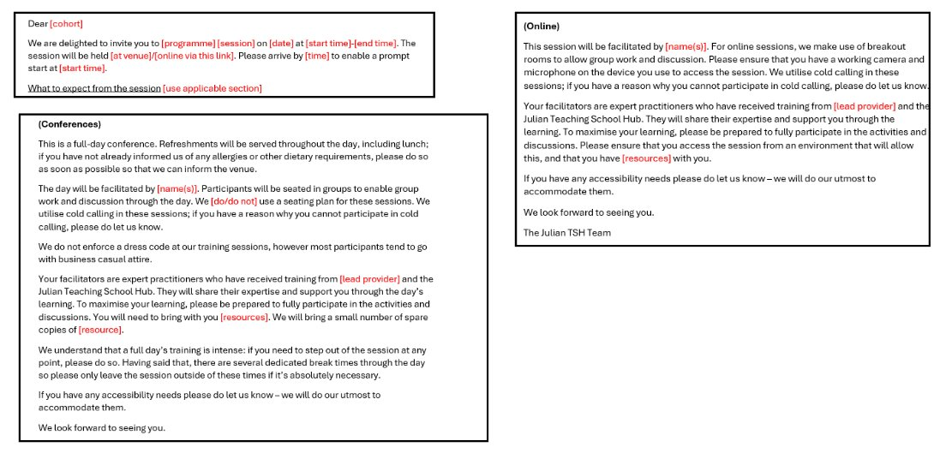
So we created the most comprehensive joining instructions possible:
- How the room will be set up
- The format of the day
- What to wear
- Who the facilitators are and why they are experts worth learning from
- When you can and can’t leave the room.
And then similar for online delivery – including our expectations around active participation.
We also stated repeatedly that we will work to accommodate anything over and above this – as long as we know about it.
In school, you can also consider the tools required to access the learning, from “does everyone have access to a laptop, webcam, and reliable wifi?” to “if someone does not want to use a particular tool or EdTech, will they be materially disadvantaged in accessing this learning?”
A useful quick test is to picture a TA, a highly experienced teacher with dyslexia, and someone who works part-time to accommodate caring responsibilities. Are all three able to access the learning effectively? Not equally! But effectively.
Who gets the NPQs, acting-up roles, the tap on the shoulder?
Moving on to career progression: who gets the opportunities – the NPQ, the informal development, the secondment? Is it the people who speak up? Maybe. But let’s also think about those who don’t have the confidence to put themselves forward.
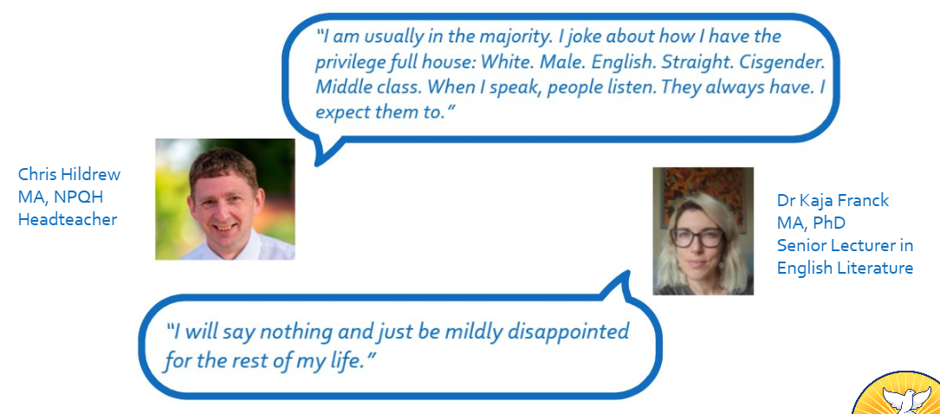
Two highly qualified people in senior roles. Chris is used to being heard; he expects it, and so he feels safe to speak up. By contrast, this quote from Dr Franck is from a podcast she was on: she’d been asked by a colleague why she hadn’t put herself forward for an opportunity. “Oh no, I couldn’t!” she said, “I will say nothing and just be mildly disappointed for the rest of my life.”
As leaders, it’s our job to advocate for people whose voices – for whatever reason – are not so easily heard. It’s also our job to interrogate why their voices are not heard: are we making assumptions about them based on our own biases; are they being judged against non-specific metrics; are we simply not listening to them?
Question: What percentage of support staff are satisfied with their career progression?
Answer: Only 36 per cent. And 42 per cent are neither satisfied nor dissatisfied, which suggests that progression isn’t even part of the conversation/hasn’t even entered the chat.
We’ve thought a lot so far about different types of individual diversity and how to be inclusive of them. I’d also like to think about diversity of role. Are support staff fully included in our conversations about inclusive development opportunities?
There have been two recent reports on the state of the support staff workforce: one by DfE and one by the NFER. The data is interesting.
Support staff exit rates are rising, and school leaders are finding it increasingly difficult to replace them. Given that the most common reason given for considering leaving is that support staff do not feel valued – and that this is backed up by the fact that “average support staff pay is comfortably in the bottom half of the wider labour market in England” (the NFER) – this recruitment crisis should not surprise us.
80% of support staff report carrying out tasks outside their job description at least some of the time. School leaders say that such support staff flexibility is “essential for schools to function effectively and keep pupils safe." Meanwhile, 24% of support staff feel that they cannot manage their workload.
It has historically been generally expected that school support staff positions are attractive to parents of young children due to school hours/term-time-only contracts. But non-student-facing administrative staff often work full-time office hours in term time, meaning that in actuality, better-paid jobs offering hybrid working in other sectors may be more attractive.
There is also a distinct lack of career progression or development for support staff. For student-facing support staff in particular – but not exclusively – the ultimate goal is often presumed by teachers or line managers to be a career in teaching, with student-facing support merely a stepping stone to a more high-value profession. This is not borne out by the data: among TAs, 34% report being interested in teacher training – still a minority. Among support staff as a whole, 72% are not interested in teaching as a career.
Just under 40% of support staff consider that their pay is unfair compared to others in their organisation and 72% are dissatisfied with their salary.
We know there isn’t a magic money tree, but there are other ways to support non-teachers – especially those who are not student-facing. Consider lifestyle benefits: for example, an early finish on a Friday, or discretionary time off in term time. Consider also that career development looks very different for support staff – think about more informal opportunities such as facilitating attendance at conferences or networking events.
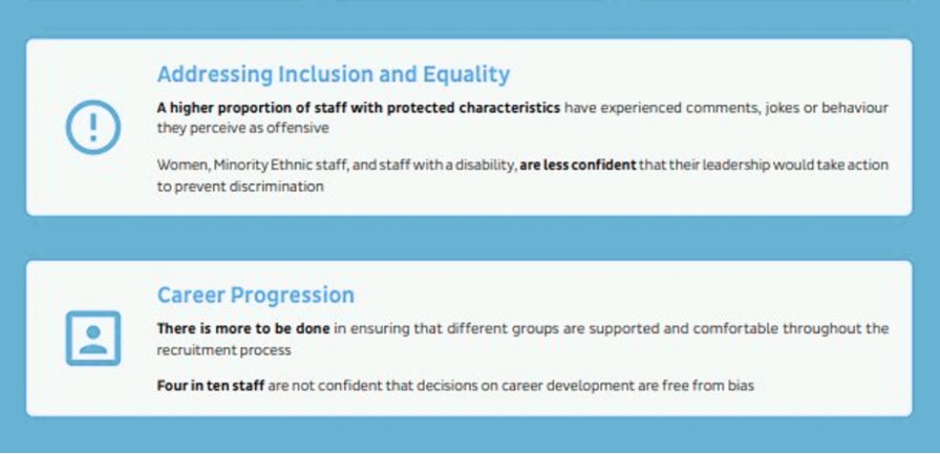
I’d like to also think about more formal career progression: internal promotions and routes into senior leadership – because, of course, the aim is to grow our own. Inclusive practice is just as important here, and the earlier points about recruitment absolutely apply. But there are still significant barriers.
Obviously, people new to the organisation – and to teaching, let’s not forget – undergo a formal induction process, but what about internal promotions? Are colleagues expected to pick up a new role organically as they go? Might under-represented groups be more likely to apply for promotion if they could be assured that they wouldn’t just be left to sink or swim, and be judged accordingly? It can feel very exposing if you are part of a minority group to be expected to go it alone.
Mothers and people experiencing menopause are particularly vulnerable. Mothers requesting part-time working may have their professional commitment questioned, when actually some flexibility on the school’s part could be enough for them to thrive. People experiencing menopause not only have to contend with a myriad of physical and emotional symptoms, but also the (thankfully on the wane) societal taboo of talking about it, and the potential for actual or perceived ageism coming into play.
And then, of course, people from most ethnic minority groups are less likely to progress to the next stage of their career than their white counterparts.
We need to acknowledge the vulnerability that these groups – and others – may feel when advocating for their needs before, during, and after a promotion or role change.
The fourth part of this series will focus on belonging.